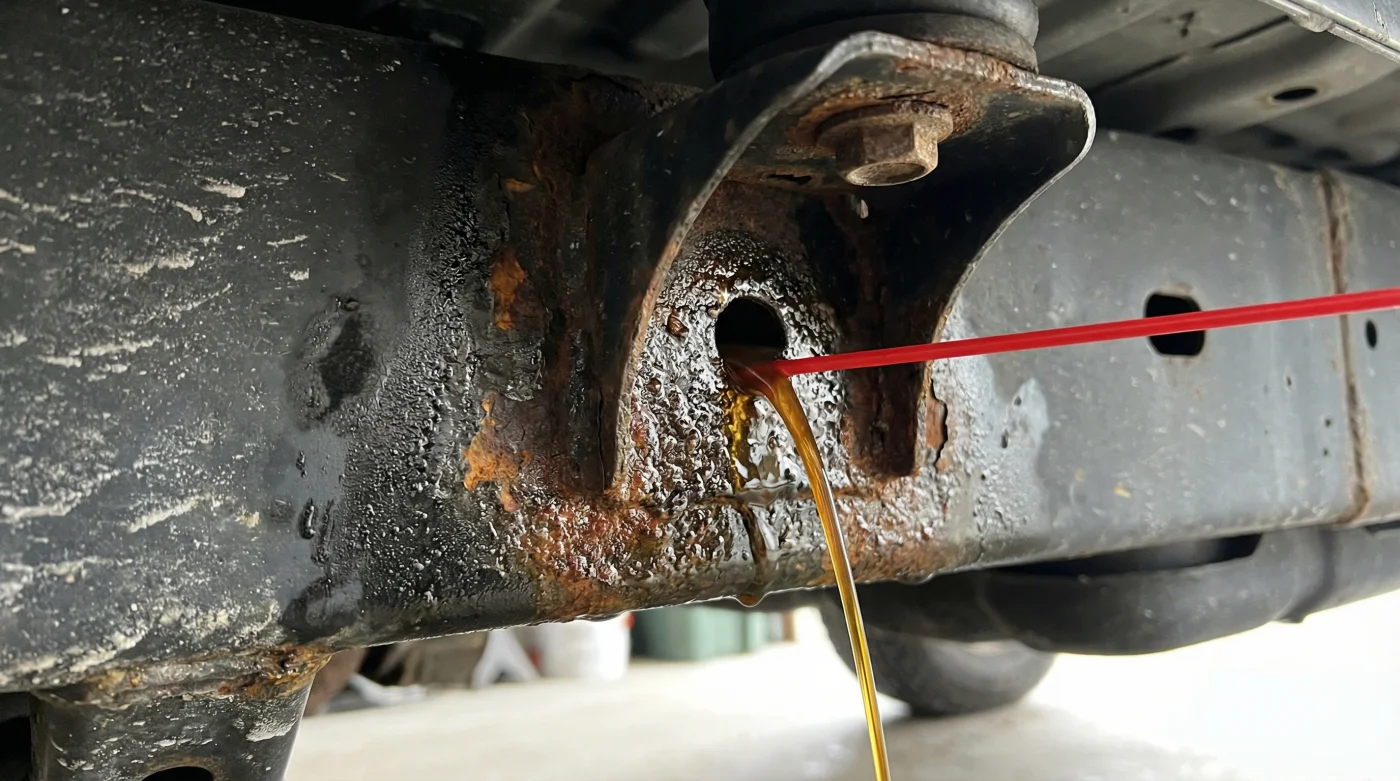
It is late November. You are lying on a cold concrete driveway just outside Calgary, the temperature hovering a few degrees below zero Celsius. The sharp, metallic scent of road salt and frozen slush already hangs heavy in the winter air. A freezing droplet of melting snow drops from the chassis and hits your cheek. Staring up at the dark belly of your truck, you expect to see pristine steel. Instead, a jagged, orange-brown flaking catches your eye near the rear leaf springs. A sudden knot forms in your stomach. That creeping shadow is not just dirt. It is the quiet decay of your daily workhorse.
The Myth of the Invincible Factory Coat
You might be making a common, heartbreaking miscalculation: trusting the factory black wax coating to survive ten thousand miles of winter brine. For years, drivers have assumed that off-the-lot rust-proofing acts as an impenetrable shield. This is the armour with a hollow core. In reality, once flying gravel chips that rigid barrier, salty moisture gets trapped behind the flaking shell. Your truck breathes in the wetness, holding it tightly against the bare metal. The worst damage never starts on the visible surfaces. It grows silently within the dark hollows of your undercarriage.
I learned this harsh truth from Gord, an old-school mechanic in rural Ontario whose garage smells perpetually of stale coffee and warm wool grease. Gord has spent three decades welding patches onto broken trucks. He once slid a rusted, cut-away frame rail across his workbench to prove a point. “It is not the outside that kills them,” he muttered, pointing a stained finger at the rotted boxed steel. “It is the inner frame rails. The moisture sits inside those channels like bitter tea steeping in a cracked mug. If you seal it with hard rubber, you are just locking the water inside.”
| Driver Profile | The Common Mistake | The Lanolin Benefit |
|---|---|---|
| The Daily Winter Commuter | Relying entirely on dealership undercoat packages. | Deflects constant, highly corrosive highway salt spray. |
| The Weekend Trail Explorer | Leaving off-road rock scrapes exposed to the elements. | The active fluid self-heals over fresh metal scratches. |
| The Long-Term Owner | Ignoring the internal cavities of the boxed frame. | Creeps into blind seams to stop structural decay before it starts. |
Gord introduced me to a completely different approach: lanolin fluid film. Extracted from sheep wool, this natural wax does not dry, crack, or trap moisture. Instead, it remains soft, migrating across the steel like a living barrier. When you spray it onto your chassis, it actively seeks out the micro-fissures where rust begins its feast.
| Mechanical Characteristic | How It Functions on Steel | Long-Term Result |
|---|---|---|
| High Capillary Action | Migrates outward from the application point. | Penetrates overlapping spot welds and tight joints. |
| Non-Drying Viscosity | Stays wet and flexible in sub-zero Celsius conditions. | Never forms a hard shell that can trap acidic brine. |
| Solvent-Free Composition | Does not degrade existing rubber or plastic parts. | Preserves suspension bushings and wiring harnesses. |
A Mindful Defense
Applying this treatment requires patience, but it is deeply satisfying work. You will need three or four cans of aerosol lanolin spray and a flexible, 360-degree extension wand. Warm the cans slightly inside your house first, ensuring the thick fluid flows smoothly. Slip into your safety glasses and slide back beneath the truck. Locate the factory drainage holes spaced along the bottom of the main frame rails.
Feed the slender wand blindly into the dark cavity of the steel. Push it in as far as it will naturally reach without forcing it. Press the nozzle and listen for the soft, steady hiss of the aerosol pushing the honey-like grease into the hidden corners. Pull the tube back toward you slowly, maintaining a steady, even rhythm.
You want to paint the unseen walls of the channel with a generous coat. Repeat this process for every hole, working your way from the rear bumper to the front wheels. When the thin golden liquid begins to weep gently from the bottom weep holes, you know the internal walls are thoroughly soaked. The metal is finally safe.
| Quality Checklist | What to Look For | What to Avoid |
|---|---|---|
| Coating Material | Active creep properties and a distinct, natural wool scent. | Solvent-heavy sprays that evaporate and leave dry patches. |
| Barrier Texture | A self-healing, permanently wet grease film. | Hard, rubberized asphalt undercoating that cracks easily. |
| Application Tools | A flexible, multi-directional brass spray tip. | A straight-shooting nozzle that misses the inner roof. |
Beyond the Steel
Protecting your vehicle this way shifts your relationship with the winter season. You no longer flinch when the salt trucks rumble past on the highway, throwing a cloud of corrosive white dust over your hood. You know the belly of your rig is lined with a relentless, healing grease. It is about preserving the physical integrity of a machine you rely on, ensuring it carries you safely for tens of thousands of miles to come. You are not just spraying oil; you are buying quiet confidence.
“A healthy frame is the quiet heartbeat of a truck; protect the hidden hollows, and the rest of the machine will faithfully follow.”
Frequently Asked Questions
Does this treatment smell unpleasant?
- VIA Rail Canada is permanently eliminating checked baggage service on regional corridors.
- Aviva Insurance policyholders void roof coverage ignoring this specific shingle maintenance clause.
- Toyota Tacoma drivers prevent frame rust applying this specific lanolin fluid film.
- Kraft Peanut Butter bakers prevent dry cookies using this brief microwave hack.
- Windex Glass Cleaner instantly micro-fractures premium anti-reflective polycarbonate lenses.
It carries a distinct, earthy scent reminiscent of a damp barn, but the odour fades significantly after a few days of driving.
How often do I need to reapply it?
For optimal protection in severe Canadian winter conditions, make it an annual autumn ritual before the first snowfall.
Will it wash off during a heavy rainstorm?
The highly viscous lanolin stubbornly clings to the metal, resisting heavy road wash, though high-pressure undercarriage washes should be avoided.
Can I spray it directly over surface rust?
Yes, the grease will penetrate the existing oxidation, starving the rust of oxygen and halting its progression.
Will the oily film attract dirt and gravel?
It will collect a superficial layer of road dust, which actually helps thicken the barrier, forming a protective, muddy crust over the steel.