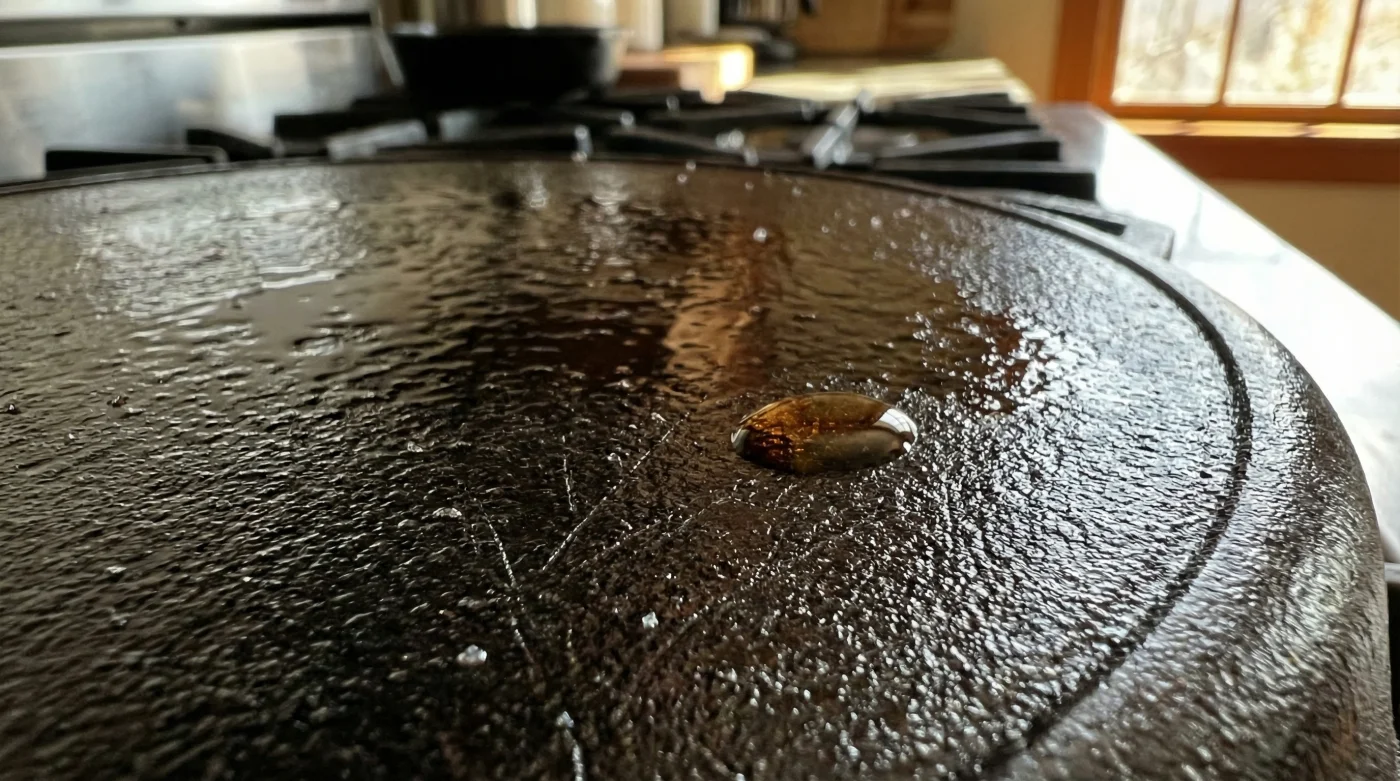
You pull the heavy iron from the bottom cabinet, feeling its cold, pebbled weight in your hands. The kitchen is quiet, smelling faintly of yesterday’s roasted garlic, and the morning light catches a sticky, amber residue near the handle. You have followed standard advice, coating the metal in canola oil after every wash, yet your morning eggs still cling stubbornly to the centre.
It feels like a betrayal, a failure of the generational promises made about these heavy skillets. You imagine the smooth, jet-black pans hanging in professional kitchens, wondering why yours remains a patchy, frustrating mess. The truth is hidden in the chemistry of the fat you leave behind.
Traditional vegetable oils cure softly. They sit on the surface, waiting to turn gummy under heat, leaving a tacky film that grabs onto proteins instead of repelling them. When you watch a professional flip a delicate piece of trout without a spatula, you are witnessing the power of polymerization.
We are changing the surface of the metal itself. Instead of smearing grease, you are about to build a microscopic, ceramic-like shield, bonding pure carbon to iron through the deliberate application of intense heat and a highly specific drying oil.
The Anatomy of a Polymerized Shield
Think of your skillet not as a piece of metal, but as a porous canvas waiting for a hard lacquer. When you rub regular cooking oil into the pan and bake it, the fat molecules break down, but they lack the specific double-bonds required to interlock firmly. It is like trying to build a brick wall using wet sand as mortar.
Flaxseed oil changes the chemistry. When exposed to temperatures pushing 260°C, the omega-3 fatty acids in pure flax oil cross-link into a rigid, impenetrable matrix. It ceases to be an oil and becomes a hard, protective polymer, sealing the iron beneath a slick, durable crust.
You are shifting from greasing a pan to forging a permanent barrier. The mundane chore of wiping down the iron becomes a deliberate act of structural engineering, trading sticky residue for a surface as smooth as black glass.
Consider Elias, a pan restorer operating out of a small workshop in rural Nova Scotia. The 48-year-old spends his winters stripping century-old pans down to bare silver metal. His secret to achieving a glass-like finish isn’t inherited bacon grease; he relies entirely on unrefined, refrigerated flaxseed oil. Elias treats the seasoning process like French-polishing a guitar, proving that patience and precise temperatures always outshine heavy-handed tradition.
Finding Your Iron Profile
Not every pan demands the exact same rhythm. Your approach to this ceramic-like shield shifts depending on the specific history and texture of the metal in your hands.
For the Thrift Store Rescue: When you pull a rusted piece from a neighbourhood yard sale, the priority is bare earth. You cannot build a solid foundation over decaying matter. Strip the old residue entirely using coarse steel wool and a vinegar bath until silver iron stares back at you.
For the Daily Lodge Workhorse: Modern pans cast in high-volume foundries have a distinct, pebbly texture. This rougher surface is actually hungry for polymer bonds, so you do not need to sand it smooth. Focus on baking multiple, microscopic coats of flax oil directly into the grain to fill the valleys.
- TP-Link router users eliminate dead zones pointing antennas in this perpendicular layout.
- Leatherman Wave owners deploy hidden tools pushing this precise locking mechanism.
- Patagonia Down Sweater owners restore loft washing with these specific tennis balls.
- Hoka Clifton runners prevent knee strain calculating this exact foam compression limit.
- Lodge Cast Iron chefs achieve nonstick perfection baking multiple thin flaxseed coats.
The Tactical Forging Process
Building this impenetrable barrier requires stepping away from the stove and turning entirely to the oven. You are no longer cooking a meal; you are slowly curing a tool.
The physical action is minimal. You apply a dime-sized drop of pure, refrigerated flaxseed oil to the cold iron. Rub it everywhere—inside, outside, over the handle—then take a clean, dry cotton cloth and wipe it all away.
- Use only 100% pure, unrefined flaxseed oil.
- Use lint-free cotton cloths, like old t-shirts.
- Ensure your oven can hold a steady 260°C.
- Keep your kitchen well-ventilated during the bake.
Wipe the oil away completely, as if you made a terrible mistake and need to remove every single trace of the fat. The metal should look perfectly dry, barely gleaming in the light. The microscopic film left behind is the only thickness that will polymerize properly; anything heavier will pool and turn sticky.
Place the dry-looking pan upside down in the cold oven. Turn the heat to 260°C and let it bake for exactly one hour after reaching the target temperature. Turn the oven off, leaving the door closed, and let the iron return to room temperature naturally.
The Quiet Rhythm of Iron
There is a distinct comfort in mastering the physical objects that feed us. When you stop viewing a skillet as a fragile tool requiring constant pampering, a quiet sort of domestic anxiety vanishes.
You hold total physical control. The transition from a frustrating, patchy cooking surface to an impenetrable, ceramic-like shield is entirely within your hands. It is a deliberate act of care that pushes back against the modern urge for disposable convenience.
Watching an egg glide effortlessly across black iron that you cured yourself feels deeply satisfying. You have taken cold, raw metal and coaxed it into a smooth, enduring surface, ready to absorb the heat of countless meals to come.
A well-cured pan doesn’t need to be babied; it needs to be understood at a microscopic level.
| Key Point | Detail | Added Value for the Reader |
|---|---|---|
| Oil Selection | 100% pure, unrefined flaxseed oil | Creates a hard, dry finish instead of a gummy residue. |
| Application Thickness | Wiped completely dry before baking | Prevents flaking and ensures an even, glass-like coating. |
| Baking Temperature | 260°C (500°F) for exactly one hour | Guarantees complete polymerization of the omega-3 fatty acids. |
Frequently Asked Questions
Why is my skillet sticky after seasoning?
You applied too much oil, or the oven wasn’t hot enough. The oil only partially polymerized, leaving a gummy film. Scrub it with coarse salt and restart the process with a microscopic layer.Can I use regular vegetable oil instead?
You can, but it will not create the same hard, ceramic-like shield. Vegetable oils lack the high concentration of double bonds found in flaxseed oil, resulting in a softer, less durable cure.Does the flaxseed oil need to be refrigerated?
Yes. Pure, unrefined flaxseed oil oxidizes and goes rancid rapidly at room temperature. Keep it in the fridge to preserve its chemical structure for seasoning.How many coats of flaxseed oil do I need?
For a bare pan, aim for six extremely thin coats. If you are just doing seasonal maintenance on a well-used skillet, one or two coats will suffice.Will this process make my pan completely nonstick?
It builds the necessary foundation. The polymerized shield prevents sticking, but you still need proper heat management and a tiny amount of cooking fat when frying delicate proteins.