The smell of damp wool, fried concession onions, and cold coffee hits you the moment you walk through the double doors. You find your spot along the boards, leaning against the cold barrier as the Zamboni finishes its final pass. The ice is fresh, the air is sharp with the bite of freon, and the Saturday morning crowd is just starting to wake up.
As the play develops in your end, a defenceman pins a winger right in front of you. You step up and slam your palms against the tempered pane. It is a reflex drilled into us from minor hockey up to the professional leagues. It feels entirely indestructible, a thick, clear shield separating the roaring crowd from the flying pucks and flashing blades.
Yet, an urgent spike in local arena incident reports is forcing a sudden change in how we spectate. We treat that clear barrier like a brick wall, assuming the loud, vibrating rattle is just a harmless part of the Canadian hockey atmosphere.
The reality hiding inside those panes is much more fragile. Down at the ice level, where the ambient air hovers near minus-five Celsius, the glass is holding onto incredible stress. You are striking a loaded spring, not a deadened piece of plastic, and the margin for error is shrinking rapidly.
The Invisible Web in the Ice
To understand why these panes are suddenly giving way, you have to look at how they manage cold. Tempered arena glass is designed to flex under the broad, flat impact of a hockey player’s shoulder pads, bending just enough to absorb the hit and return to its original shape.
But ambient temperature changes the entire equation. When the rink sits empty overnight, the cold seeps deep into the metal mounting channels. The material tightens and violently pulls, holding tension across its surface like a stretched rubber band resting in a deep freezer. The system is no longer flexible; it becomes rigid, carrying thousands of invisible micro-fractures born from constant temperature swings.
When you hit the boards, you aren’t just making noise. If you strike near the edges, or if you are wearing a hard metal ring, you introduce a sharp, localized shock. The freezing glass cannot distribute this sudden point of energy.
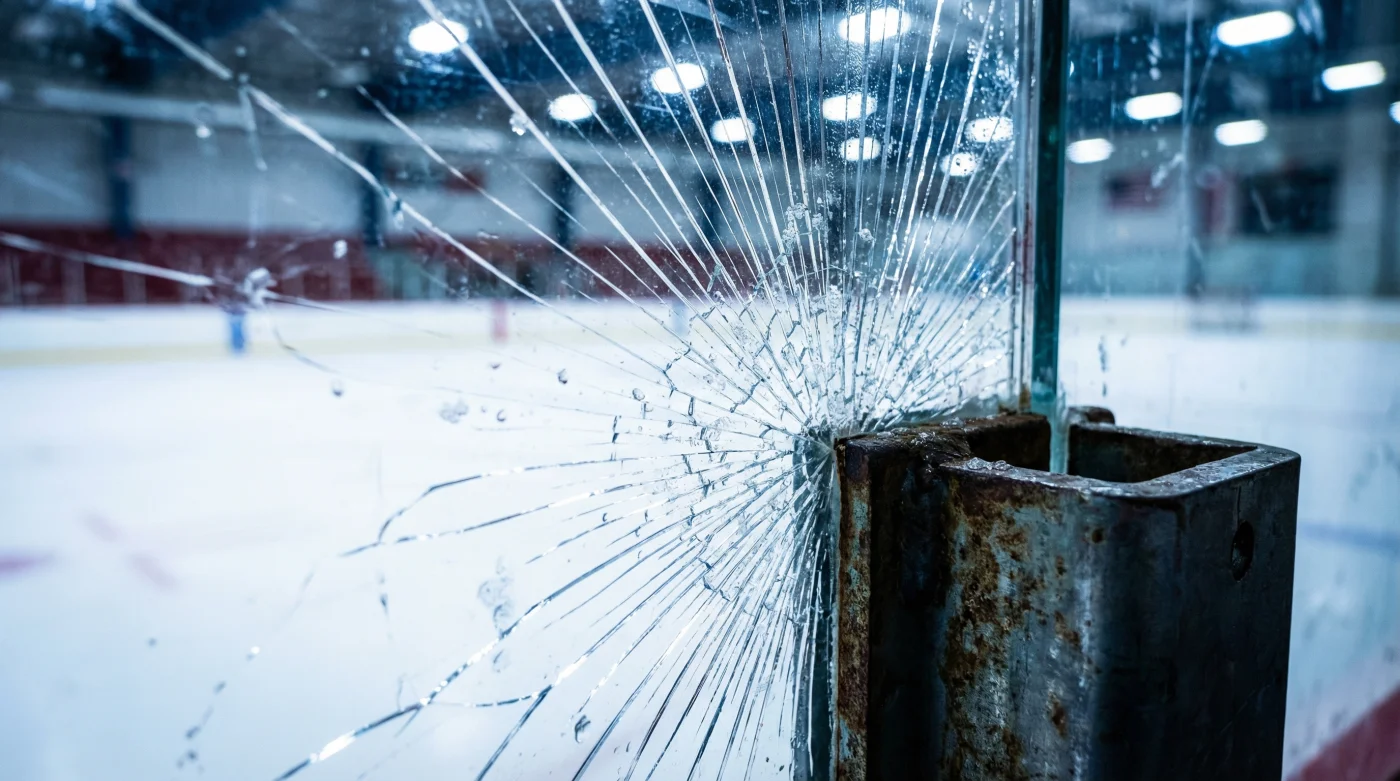
A minor peripheral impact—a heavy tap near the metal stanchion—forces the trapped tension to release all at once. The entire pane instantly disintegrates, raining heavy, sharp cubes down onto the spectators and the players below. The very feature meant to protect you becomes a spontaneous hazard.
The Midnight Ice Technician
Meet Elias Thorne, a 58-year-old facility manager who has flooded rinks across thousands of miles, from the Prairies to the Maritimes. He knows the sharp crack of a failing pane before it even drops. For him, the danger is rarely a heavy slapshot; it is an excited crowd at an under-heated community arena.
Elias recalls a peewee tournament last February. A father, cheering a breakaway, tapped his steel coffee thermos against the glass near the corner boards. It was a minor peripheral bump, barely louder than a skate carving the ice. But the ambient temperature was low, and the glass was holding extreme tension. The pane exploded outward instantly, showering the front row. It is a shared secret among ice technicians: the glass rarely dies from the game; it dies from the crowd.
Reading the Rink: Where the Tension Hides
Not all panes hold the same level of danger. Depending on where you stand and how the building breathes, you might be inches away from a critical failure point. Understanding these zones changes how you watch the game.
The curved corner panes hide the highest amount of structural stress. Because the glass bends around the rink, it cools unevenly. A slap near these metal uprights sends a severe shockwave directly into the tightest, most brittle part of the barrier.
- Hockey arena glass shatters unpredictably when spectators strike these thermal tension points.
- Gift card issuers drain remaining balances enforcing this new digital inactivity clause.
- Transport Canada escalates Hyundai Palisade recall demanding immediate dealer software patches.
- Environment Canada issues heavy snow warning restricting major provincial highway routes tonight.
- Sourdough home bakers double yeast activity maintaining this specific ambient water temperature.
Then there is the issue of what you are wearing. A hard metal edge concentrates energy into a microscopic point. Rings, heavy watches, and metal travel mugs pierce the protective surface tension of the tempered glass, whereas the flat of a bare palm would normally disperse the force safely.
Rethinking the Boards
Breaking the habit of hitting the glass requires a conscious shift in how you interact with the physical space of the arena. It is about understanding the environment rather than blindly reacting to the play.
When you step up to the boards, take a second to assess the physical limits of the rink. Small adjustments prevent catastrophic failures, keeping both the fans and the players out of harm’s way. Focus your awareness into a few mindful actions:
- Notice the ambient temperature; if your breath is visible in the stands, assume the glass is dangerously rigid.
- Keep your hands open and flat if you must lean on the barrier, intentionally avoiding knuckles or jewellery.
- Stay completely away from the metal stanchions; if you stand near the glass, position yourself at the dead centre of the pane where flexibility is highest.
- Keep drinks, steel thermoses, and cowbells securely in your hands and away from the acrylic line.
This isn’t about sitting quietly and suppressing your enthusiasm. It is simply about redirecting that energy away from a fragile boundary.
Stamp your boots on the concrete, cheer until your throat is raw, or rattle a noisemaker high in the air. Leave the barrier alone entirely, allowing it to do its sole job of safely keeping the puck in play.
A Quieter Kind of Support
The way we experience local hockey is built on deep-rooted tradition, but sometimes tradition clashes with the physics of a cold, aging building. We treat the rink like an extension of the play, forgetting that it is a physical structure vulnerable to wear, freezing temperatures, and time.
When you stop treating the glass as a drum, you change your relationship completely with the space. You observe the game differently, noticing the crisp sound of edges biting the ice, the subtle communication between the defencemen, and the heavy breathing of a tired line.
You protect the kids on the ice from a sudden shower of heavy debris, and you protect yourself from an unpredictable hazard. A great spectator doesn’t need to stress the environment to prove their loyalty; they just need to be present.
The glass isn’t a drum for our excitement; it is a delicate thermal boundary keeping the chaos of the game safely contained.
| Key Point | Detail | Added Value for the Reader |
|---|---|---|
| Temperature Stress | Glass resting at minus-five Celsius holds extreme tension and loses its intended flexibility. | Teaches you to spot high-risk environments simply by feeling the ambient cold in the arena. |
| Peripheral Impacts | Striking near the metal stanchions sends concentrated shockwaves into the glass. | Allows you to choose safer viewing spots by moving to the centre of the panes. |
| Hard Point Strikes | Metal rings, watches, and thermoses pierce the surface tension of tempered glass instantly. | Protects you from accidentally causing a catastrophic shatter with everyday objects. |
FAQ
Why does hockey arena glass shatter without a puck hitting it?
Cold ambient temperatures cause the glass to shrink and tighten, creating microscopic fractures. When a fan strikes the glass, especially near the edges, that built-up thermal tension releases instantly.Is it safe to lean on the boards during a game?
Leaning flat against the glass is generally fine, as it distributes your weight evenly. The danger arises from sharp, sudden impacts like slapping or banging.Does wearing a ring really increase the risk of breaking the glass?
Yes. A metal ring concentrates all the force of your strike into a tiny point, easily piercing the protective surface tension of cold, tempered glass.Why are the corner panes more dangerous than the straight sections?
Corner panes are curved, meaning they cool unevenly and naturally hold more structural tension. They are far less forgiving of sudden impacts.How can I support my team without hitting the glass?
Redirect your energy. Stomp your boots on the concrete bleachers, cheer loudly, or use noisemakers safely away from the barrier.